Timeline of Andean Peoples
5,000 Years of Civilization in the Andes
Introduction: The Deep History of the Andes
The Andean region of South America boasts one of the world’s longest and most remarkable records of continuous civilization. From the emergence of agriculture around 8000 BCE through the establishment of some of humanity’s greatest empires, the peoples of the Andes have created sophisticated societies, developed innovative technologies, and preserved profound spiritual wisdom. Understanding this timeline provides essential context for appreciating contemporary Andean culture and the depth of knowledge held by indigenous Andean peoples.
The archaeological and cultural record reveals not a simple linear progression but a complex pattern of rise, flourishing, transformation, and continuity. Civilizations emerged, reached peaks of achievement, and sometimes collapsed, yet the fundamental relationship between Andean peoples and their spectacular landscape—one of the world’s most challenging environments—has remained remarkably consistent.
Caral Civilization (3000-1800 BCE)
The Caral culture, dating to approximately 3000-1800 BCE, represents the oldest complex civilization in the Americas and one of humanity’s earliest sophisticated societies. Located in the Caral-Supe region of north-central coastal Peru, Caral comprised as many as thirty major population centers organized around the Sacred City of Caral itself.
Historical Significance
Caral emerged approximately fifteen hundred years before the Olmec civilization of Mesoamerica, making it the earliest known complex society in the Americas. The construction of the Sacred City of Caral began around 2600 BCE, roughly contemporary with the construction of Egypt’s earliest pyramids, yet developing entirely independently.
Unique Characteristics
What makes Caral extraordinary is not only its age but its unusually peaceful nature. Archaeological excavations have revealed no evidence of warfare, defensive walls, or weapons of war in Caral sites. Unlike most early complex civilizations, Caral’s power and influence appear to have rested on religion, trade, and agriculture rather than military conquest. This suggests a society united by shared spiritual understanding and cooperative exchange rather than by domination.
Social Organization and Culture
Caral was an agricultural society that developed sophisticated irrigation systems, allowing cultivation in the arid coastal desert. The society was hierarchically organized, with evidence of elite classes, but the social structure appears to have been less rigid than in many contemporary civilizations. The people of Caral produced textiles, ceramics, and complex architectural structures, demonstrating sophisticated artistic and engineering knowledge.
Spiritual Legacy
Religious practice appears to have been central to Caral civilization. The construction of temples and ceremonial centers, together with the apparent absence of warfare, suggests a spiritually-oriented society. Some scholars propose that the religious unity provided by shared spiritual practice may have been more effective than military force in maintaining social cohesion and cultural continuity.
Chavin Culture (900-200 BCE)
The Chavin culture, flourishing from approximately 900-200 BCE, represents a crucial transition in Andean civilization. Unlike Caral, which was primarily a coastal culture, Chavin represented the first major unification of both highland and coastal regions, creating what scholars call the first Andean horizon—a widespread shared culture that influenced diverse regions.
The Chavin Religious Movement
Chavin was primarily a religious and cultural movement rather than a political empire. The culture spread outward from the pilgrimage center of Chavin de Huantar, an impressive highland temple complex. The rapid spread of Chavin culture across such vast distances and diverse geographical zones suggests the power of shared religious belief and practice.
Spiritual and Artistic Innovation
The Chavin people developed sophisticated artistic styles featuring distinctive representations of felines (particularly jaguars), serpents, and birds, often depicted in anthropomorphic forms. These same animal motifs appear in contemporary Andean spiritual practice, suggesting continuity of spiritual understanding spanning nearly three millennia.
The Chavin culture appears to have emphasized shamanic practice, with evidence of ritual spaces, ceremonial objects, and artistic representations suggesting direct engagement with spiritual dimensions and consciousness expansion through ritual.
Technological Development
Despite their emphasis on spirituality, the Chavin people were skilled artisans and engineers. They created sophisticated textiles, pottery, and metal work, including some of the earliest complex metalwork in the Andes. Agricultural innovations allowed population growth and the support of large ceremonial centers.
Paracas Culture (700-100 BCE)
The Paracas culture of the southern Peruvian coast (700-100 BCE) is renowned as one of humanity’s greatest textile-producing civilizations. The Paracas people are known for creating the most intricate, colorful, and technically sophisticated textiles of the ancient Andean world, some surpassing in quality and complexity textiles produced in other civilizations centuries later.
Master Weavers
Paracas textiles represent an unparalleled achievement in fiber arts, featuring complex color combinations achieved through natural dyes, intricate patterns, and techniques demonstrating sophisticated understanding of textile design and production. Some Paracas textiles contained hundreds of different colored threads per inch, representing levels of craftsmanship extraordinary even by contemporary standards.
Innovation and Culture
Beyond textiles, the Paracas culture developed sophisticated pottery, ceramics, and other crafts. Archaeological excavations have revealed elaborate mummification practices and complex burial rituals, suggesting sophisticated beliefs about death and the afterlife.
The Paracas people were influenced by the preceding Chavin culture but developed their own distinctive artistic and cultural expression, suggesting creative adaptation rather than mere imitation of predecessors.
Agricultural Success
Paracas agriculture, supported by sophisticated irrigation systems, allowed the accumulation of surplus resources that freed people to devote time to artistic endeavors. The society demonstrates how investment in artistic and ceremonial life contributes to cultural richness and continuity.
Nazca Culture (100 BCE-800 CE)
The Nazca culture, flourishing along the southern coast of Peru from approximately 100 BCE to 800 CE, inherited the artistic traditions of the Paracas and carried them to new heights. The Nazca are renowned for their distinctive pottery, textiles, and most famously, for the monumental Nazca Lines—vast geoglyphs etched into the desert floor.
The Nazca Lines
The Nazca Lines represent a mystery that has fascinated scholars for generations. These enormous geometric and animal designs, etched into the desert over an area of hundreds of square kilometers, were created by removing the reddish pebbles from the desert surface to reveal the lighter ground beneath. The designs are visible primarily from the air and include representations of animals (hummingbirds, spiders, monkeys), geometric patterns, and long straight lines.
The purpose of these lines remains debated by scholars, but many propose religious or astronomical significance. Some lines are aligned with astronomical events or celestial bodies, and the designs may represent offerings to celestial deities or may have served as processional pathways for ritual purposes.
Artistic and Ceramic Achievement
Nazca pottery is renowned for its polychrome colors, sophisticated designs, and technical quality. The Nazca developed a distinctive painting style and created vessels in shapes ranging from the purely functional to the fantastically imaginative. Nazca textiles, while generally less elaborate than Paracas textiles, maintain high quality and distinctive design.
Environmental Challenge and Adaptation
The Nazca flourished in one of the driest regions on Earth, developing sophisticated water management systems (including puquios—underground aqueducts) to support agriculture in this extreme environment. The sophistication of Nazca water technology demonstrates remarkable engineering knowledge and suggests a society highly attuned to understanding and working skillfully with environmental constraints.
Moche Civilization (100-800 CE)
The Moche civilization, flourishing in the northern coastal region of Peru from approximately 100-800 CE, produced some of the finest pottery and metalwork of the ancient Americas and represents a peak of pre-Incan artistic achievement. The Moche are celebrated as some of the ancient world’s greatest potters.
Artistic Excellence
Moche pottery demonstrates exceptional technical skill and imaginative artistry. The Moche created portrait vessels, realistic representations of individuals, and narrative vessels depicting scenes of warfare, ritual, daily life, and religious ceremony. These vessels serve as a visual record of Moche society, revealing details about warfare, hierarchy, clothing, and ceremony.
Moche metalworking represents another peak of achievement, with fine objects created in gold, silver, and copper demonstrating sophisticated understanding of metal working techniques. The discovery of intact royal tombs at sites like Sipan has revealed the extraordinary quality and quantity of Moche metalwork.
Social Structure and Power
Moche society was hierarchically organized, with powerful rulers (sometimes called priest-kings) who wielded both political and religious authority. Evidence of large-scale warfare and conquest indicates that the Moche were aggressive empire-builders who expanded their territory through military force.
Engineering and Urban Development
The Moche constructed large settlements and impressive architectural complexes, including temples and administrative structures. They developed sophisticated irrigation systems and agricultural practices that supported substantial populations in the arid northern coast.
Ritual and Religion
Moche pottery frequently depicts scenes of ritual and religious practice, including ceremonies involving sacrifice. The depictions suggest a society in which religious ritual held central importance and in which divine blessing was understood to be necessary for societal prosperity.
Tiwanaku Culture (300-1000 CE)
The Tiwanaku civilization, centered on the altiplano (high plain) near Lake Titicaca, flourished from approximately 300-1000 CE and represents one of the Andes’ greatest cultural achievements. Tiwanaku was not merely a political empire but a center of spiritual and intellectual power that influenced vast regions.
Architectural and Engineering Mastery
The archaeological site of Tiwanaku, featuring the famous Gate of the Sun and the Akapana Pyramid, demonstrates extraordinary architectural sophistication. The stones of Tiwanaku structures are fitted with precision without mortar, and the site incorporates sophisticated astronomical alignments. The engineering knowledge represented in these structures indicates deep understanding of stone working, geometry, and architecture.
Agricultural Innovation
The Tiwanaku culture pioneered the use of raised-field agriculture (called waru waru or camellones), an innovative system in which fields were constructed in alternating ridges and water-filled channels. This system, developed to cultivate crops in the harsh high-altitude environment, provided exceptional yields and represented a sophisticated solution to the challenge of highland agriculture.
Artistic and Cultural Influence
Tiwanaku culture influenced vast regions through the spread of distinctive artistic styles and religious iconography. The so-called “Tiwanaku horizon” extended cultural influence across much of the Andes, suggesting either extensive trade networks or military conquest and cultural assimilation.
Spiritual Significance
Lake Titicaca itself is understood in Andean cosmology as the birthplace of Inti (the sun) and as one of the most sacred locations in the Andes. Tiwanaku’s location near Lake Titicaca gave it spiritual significance, and the culture developed in connection with this sacred landscape.
Wari Empire (600-1000 CE)
The Wari Empire, centered in the southern highlands, flourished from approximately 600-1000 CE and represented one of the Andes’ first expansionist state empires. The Wari are understood as precursors to the Inca Empire, developing many organizational and administrative systems that the Inca would later refine.
Administrative Innovation
The Wari established a decentralized administrative system in which provincial centers replicated the imperial center’s organization. This administrative structure, later elaborated by the Inca, allowed the empire to govern vast territories and diverse populations. The establishment of administrative centers, road systems, and bureaucratic hierarchies marked a significant development in Andean political organization.
Military and Territorial Expansion
The Wari were aggressive expansionists who used military force to extend their control over vast territories. Evidence of fortifications and weapons indicates that military power was central to Wari imperial success.
Cultural Synthesis
Wari culture represents a synthesis of influences from the north (Chavin and Moche regions) and the south (Nazca and Tiwanaku influences). This cultural blending created distinctive Wari artistic styles, textiles, and pottery.
Chimú Kingdom (900-1470 CE)
The Chimú Kingdom, ruling the northern coast of Peru from approximately 900-1470 CE, developed one of the most sophisticated pre-Incan coastal civilizations. The Chimú are renowned for their distinctive black pottery, their architectural achievements, and their advanced administrative systems.
Artistic and Technological Achievement
Chimú pottery, characterized by its distinctive glossy black color, represents exceptional technical achievement. Chimú metalworking, particularly the production of objects in gold and silver, demonstrates sophisticated craftsmanship. The Chimú are credited with innovations in textile dyeing and other crafts.
Urban Development
The Chimú capital of Chan Chan represents one of the largest pre-Columbian cities in South America. The site’s architecture, including distinctive adobe structures organized in compounds, demonstrates sophisticated urban planning and engineering.
Administration and Empire
The Chimú developed centralized administrative systems and territorial expansion through both conquest and diplomacy. Their organization and power structure provided a model that influenced later Inca imperial organization.
Inca Empire / Tawantinsuyu (1400-1532 CE)
The Inca Empire, known as Tawantinsuyu (the “Four Parts Together”), represents the apex of pre-Columbian Andean civilization. Emerging around 1400 CE in the region of Cusco, the Inca rapidly expanded to create the largest empire in pre-Columbian South America, encompassing an estimated twelve million people across territories spanning approximately 3,000 miles.
Rapid Expansion and Military Conquest
The Inca Empire was built through aggressive military expansion under successive rulers. By the time of the Spanish conquest in the sixteenth century, Inca territory extended from present-day Colombia in the north to central Chile in the south, encompassing diverse geographical zones, climates, and populations.
Administrative Genius
The Inca developed a sophisticated administrative system for governing their vast empire. This included the assignment of governors to regional districts, the establishment of road networks connecting distant regions, the organization of labor through the mit’a (labor tax), and the development of the quipu (an elaborate system of knotted strings for recording information).
Architectural Mastery
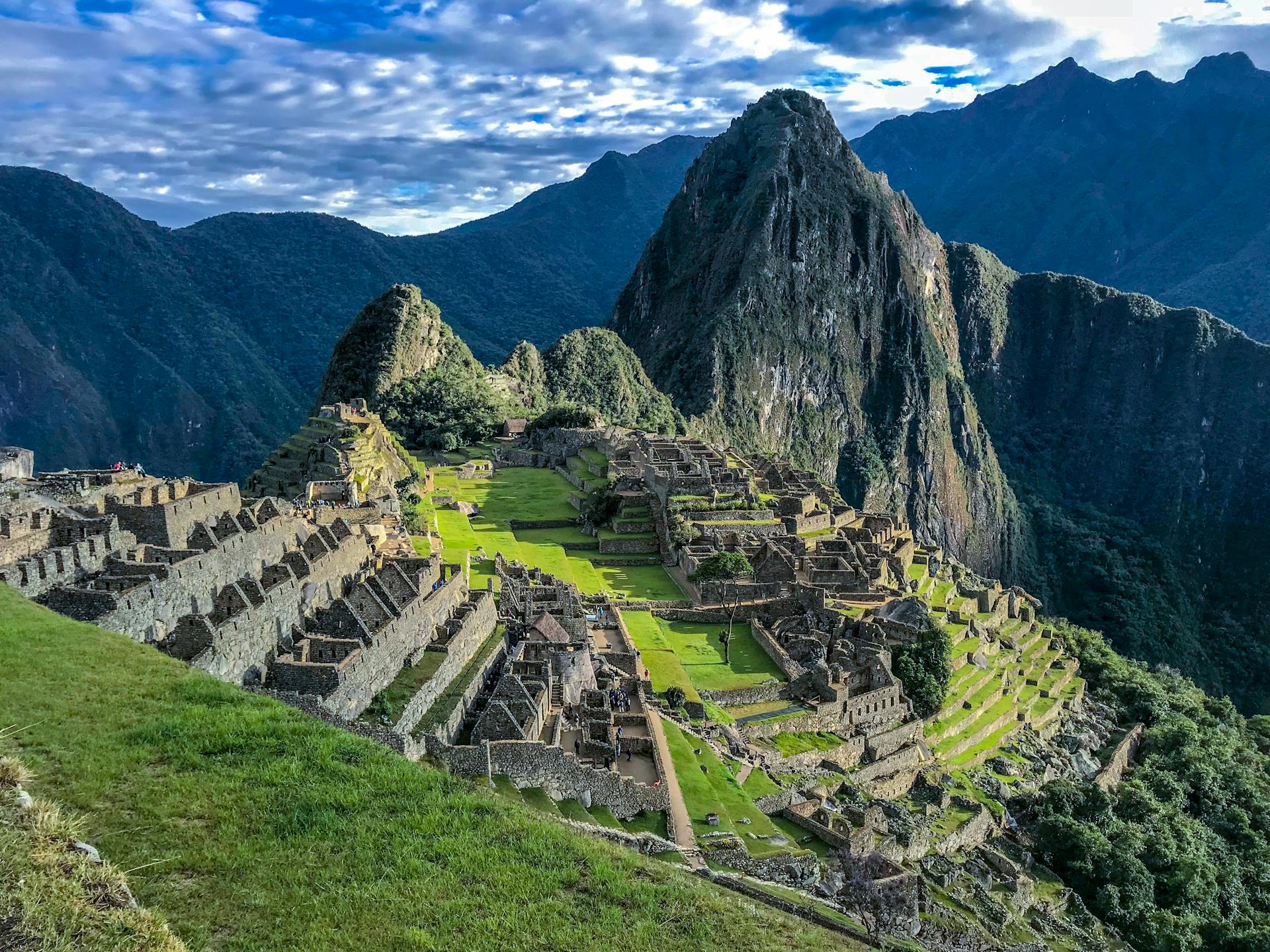
The Inca constructed impressive structures, including temples, fortresses, and administrative centers. Machu Picchu, Sacsayhuaman, and other Inca sites demonstrate exceptional architectural and engineering knowledge. Inca stonework, featuring precisely fitted stones without mortar, represents one of the world’s greatest achievements in dry stone construction.
Spiritual and Cultural Achievements
Inca civilization integrated the diverse cultures under their control through a combination of military power, administrative control, and religious unity. The cult of Inti (the sun god) provided spiritual cohesion across the empire. The Inca maintained and elaborated on the artistic and spiritual traditions inherited from earlier Andean cultures.
The Spanish Conquest (1532 CE)
The arrival of Spanish conquistador Francisco Pizarro in 1532 initiated the conquest of the Inca Empire. Despite the Spanish being outnumbered, they possessed military advantages (horses, metal armor, firearms) and exploited internal divisions within the Inca Empire, ultimately conquering the empire by 1572.
The Q’ero: Living Descendants and Keepers of Tradition (Contemporary)
The Q’ero people, numbering approximately two thousand individuals living in remote mountain communities above Cusco, represent the most direct continuity with Inca civilization and tradition. The Q’ero are understood as the last unconquered Inca, having maintained their communities, language, and spiritual practices with remarkable continuity despite five centuries of external pressure.
The Q’ero remained virtually unknown to the outside world until their public revelation in 1955, when they chose to share their sacred teachings with the broader world. Today, Q’ero paqos (shamanic teachers) work with students worldwide, preserving and transmitting Andean wisdom traditions.
Quechua People (Contemporary)
The Quechua people, numbering several million individuals throughout the Andes, represent the descendants of the Inca Empire and earlier Andean peoples. The Quechua language, derived from the language spoken by the Incas, is still spoken by millions of people in Peru, Ecuador, Bolivia, and other Andean regions.
Quechua communities throughout the Andes maintain elements of traditional culture, language, and spiritual practice, though to varying degrees depending on geographical location and historical circumstances. Many Quechua communities blend traditional practices with Catholicism and other external influences while maintaining core aspects of ancestral wisdom.
Aymara People (Contemporary)
The Aymara people, living primarily in the region around Lake Titicaca in Bolivia and Peru, represent another major indigenous group with deep roots in Andean civilization. The Aymara maintain their own language and cultural traditions, with some scholars suggesting that Aymara peoples may represent continuity with pre-Inca populations who inhabited the region.
Aymara culture maintains distinctive spiritual practices, textiles, and social organizations. The Aymara have developed their own expressions of Andean shamanism and maintain sacred relationships with their landscape and spiritual forces.
Shipibo-Conibo (Amazonian Andean)
The Shipibo-Conibo peoples, living in the Amazonian lowlands on the eastern slopes of the Andes, represent another indigenous group with deep historical roots in the region. The Shipibo-Conibo maintain sophisticated shamanic traditions and are renowned for their distinctive geometric textiles and their knowledge of medicinal plants.
While geographically located in the Amazon rather than the high Andes, the Shipibo-Conibo represent another strand of indigenous South American tradition influenced by and interconnected with Andean peoples.
Mapuche (Southern Andes)
The Mapuche people, inhabiting the southern Andes and the territories of present-day Chile and Argentina, represent another indigenous group with distinctive culture and spiritual traditions. The Mapuche maintained their independence longer than most South American indigenous peoples, resisting both Inca and Spanish conquest for extended periods.
Mapuche shamanic traditions, while distinctive, share some elements with broader Andean shamanism, reflecting historical contact and cultural exchange across the Andes.
Conclusion: Continuity and Living Tradition
The timeline of Andean civilization reveals not a simple progression from primitive to advanced but a complex, sophisticated development of multiple civilizations, each building on the knowledge of predecessors while creating distinctive achievements. What is most remarkable is the continuity—the way that fundamental principles of Andean spirituality, social organization, and relationship with the land have persisted across three thousand years of change and challenge.
From Caral’s peaceful cooperation to the Inca’s vast administrative networks, from the Nazca’s monumental earth art to the Moche’s narrative pottery, from Tiwanaku’s agricultural innovation to contemporary Quechua and Aymara communities, Andean peoples have demonstrated remarkable creativity, resilience, and commitment to maintaining sacred relationship with their extraordinary landscape.
Today, the indigenous peoples of the Andes—the Q’ero, Quechua, Aymara, Shipibo-Conibo, Mapuche, and many other communities—continue as living representatives of this ancient tradition, maintaining knowledge and practices that span millennia and offering wisdom profoundly relevant to contemporary challenges and human development.